
In the digital era, the most valuable asset your business owns is the traffic you’ve already earned. For a small business in Padova—whether you’re running a boutique in the Centro Storico or a specialized service in the industrial zones—the majority of your website visitors will leave without making a purchase or inquiry on their first visit.
Retargeting is the “second chance” every business needs. It is the strategy of showing tailored ads to people who have already interacted with your brand, keeping you top-of-mind and nudging them toward a conversion. In this guide, we explore how to build high-performance, cost-effective, and GDPR-compliant retargeting campaigns tailored to the unique Padova marketplace.
1. The Cost of Lost Website Traffic in Padova
Every single day, hundreds of potential customers browse local Padova websites. A resident on Via VIII Febbraio looks up a local dental clinic because they need a wisdom tooth extracted. A tourist sitting at a café in Piazza delle Erbe browses the collection of a nearby leather goods shop. A homeowner in Arcella searches for an emergency plumber to fix a leaking boiler.
But here is the brutal reality of digital marketing: roughly 96% to 98% of those people will leave your website without filling out a form, making a phone call, or buying a single thing.
When a visitor clicks away from your site, they do not just vanish; they forget you. They get distracted by an incoming WhatsApp message, they close the browser tab to catch the tram at Prato della Valle, or they simply get overwhelmed by choices and decide to look into it later. By the time they are ready to make a decision, your name has slipped their mind, and they often end up choosing a competitor who happened to pop up at the right place and time.
For a small business owner in Padova working with a modest marketing budget, this isn’t just an administrative statistic—it is a direct drain on your hard-earned cash. If you are paying for Google Ads to bring people to your site, or if you have spent countless hours optimizing your local SEO to rank for terms like “idraulico Padova” (plumber Padova) or “commercialista vicino a me” (accountant near me), losing those visitors on the first turn means your initial investment is going down the drain. You have already done the hardest part, which is getting their attention. Letting them walk away forever without a gentle reminder is leaving easy revenue on the table.
2. What Exactly is Retargeting and How Does It Work?
Retargeting is a smart digital advertising method that keeps your brand visible to people after they leave your website. Think of it as a friendly, digital follow-up.
To understand it in everyday, human terms, let’s look at a real-world scenario that happens all the time in our city:
Imagine a local resident walks into an independent clothing boutique near the Palazzo della Ragione. They spend fifteen minutes looking at a beautifully crafted, locally made wool coat. They feel the fabric, check the price tag, and even try it on. It looks great, but they hesitate. They aren’t quite ready to drop a couple of hundred euros on an impulse buy, or maybe they are simply late for a lunch date with friends. They tell the shop owner, “I’ll think about it,” and walk out the door.
In the physical world, once that person walks down the cobblestone street, the boutique owner has no way to contact them again. They just have to cross their fingers and hope the customer returns.
[PICTURE PROMPT: A split-screen illustration. On the left side, a frustrated shop owner stands at the doorway of a boutique in Centro Storico, watching a customer walk away into a crowded street. On the right side, the exact same customer is sitting on a bench at Prato della Valle, looking at their smartphone screen which displays a beautiful, well-timed Instagram ad showing the exact wool coat they were just looking at with a ‘Free pickup in-store’ offer.]
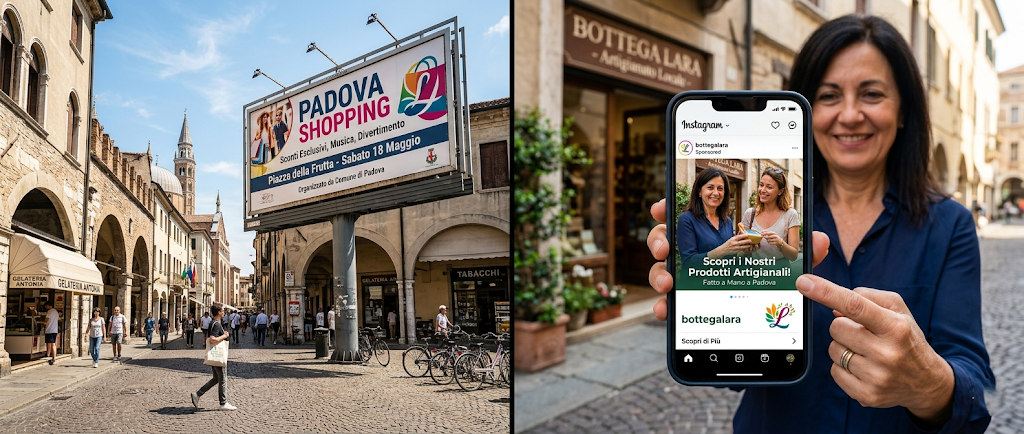
In the digital world, retargeting acts as that invisible, polite shop assistant who follows up at just the right moment. When that same customer visits your online store, views that specific wool coat, and leaves, a tiny piece of anonymous tracking code on your website notes their visit. Later that evening, while they are scrolling through their Instagram feed while relaxing at home, or reading a local news article on Mattino di Padova, an ad pops up featuring the exact same wool coat they were admiring earlier.
The ad might include a simple message like, “Still thinking about it? Drop by our boutique this week to try it on again, or enjoy free shipping across the Veneto region.” It bridges the gap between initial curiosity and a final sale. You are not cold-calling random strangers; you are simply continuing a conversation with someone who already walked into your shop and showed genuine interest.
3. Why This Strategy is the Ultimate ROI Engine for Small Budgets
Many small business owners in Padova assume that digital advertising is a luxury reserved for multi-national corporations or massive e-commerce chains with tens of thousands of euros to throw around. This misconception causes small businesses to miss out on incredibly profitable opportunities. The truth is that retargeting is actually the single most cost-effective ad strategy for a small business precisely because your budget is limited.
When you run a standard awareness campaign to find new customers, you are casting a wide net across the province of Padova. You are paying to show your ads to thousands of people who might have absolutely no interest in what you sell, or who aren’t in the market for your services right now. That is a costly way to learn who your audience is.
Retargeting turns that model on its head by focusing only on high-intent users. Here is why it stretches your marketing budget further than any other approach:
- You bypass the discovery phase: You are completely skipping the expensive step of introducing yourself to strangers. The people seeing your ads already know your name, know what you look like, and know what you sell. This familiarity breeds trust, and trust is what drives conversions.
- Incredibly low waste: If your website only gets 1,000 visitors a month, your retargeting audience is exactly 1,000 people. Instead of spending money trying to reach all 930,000 residents in the province of Padova, you are only spending a few euros a day to show ads to the specific 1,000 people who have already raised their hands and said, “I am interested in what you do.”
- Cheaper clicks and better conversions: Because platforms like Meta and Google reward ads that get high engagement, and because people are far more likely to click on an ad from a brand they recognize, your Click-Through Rates (CTR) shoot up while your Cost-Per-Click (CPC) plummets. You stop wasting money on empty clicks and start paying for real results.
4. Navigating the Strict Reality of Privacy and GDPR in Italy
You cannot discuss digital tracking in Italy without addressing privacy regulations. Italy’s data protection authority, the Garante per la protezione dei dati personali, is notorious for being one of the strictest and most active enforcement bodies in the entire European Union. If you are going to run retargeting campaigns for your Padova business, you must do it properly, legally, and ethically. Running tracking pixels without user consent can result in heavy fines and permanent damage to your local reputation.
[PICTURE PROMPT: A clean, close-up shot of a smartphone screen displaying a beautifully designed, clear, and user-friendly cookie consent banner on a local Italian website. The banner has distinct ‘Accept All’, ‘Reject All’, and ‘Manage Preferences’ buttons that are equal in size and color, perfectly complying with the Italian Garante regulations.]
To ensure your local campaign remains fully compliant, you need to establish three core pillars of data privacy on your digital storefront:
Explicit, Active Consent
You cannot drop a Meta pixel, a Google tag, or any other tracking cookie onto a visitor’s device the moment they load your site. Your website must feature a compliant cookie banner that blocks all tracking scripts by default. The tracking can only activate after the user explicitly clicks an “Accept” button.
Furthermore, under the Garante’s updated guidelines, your banner must feature an easy-to-find “X” close button or a clear “Reject” option that allows users to decline tracking just as easily as they can accept it. The colors and sizes of the buttons must be balanced so you aren’t manipulating the user into clicking accept.
Transparent Documentation
Your website needs a comprehensive, up-to-date Privacy Policy and Cookie Policy written in clear, accessible Italian. This document must explicitly state which third-party tools you use (such as Meta Ads, Google Analytics, or Google Ads), what data they collect (like IP addresses and page views), and exactly how that data is used to serve personalized advertisements.
The Power of Local Compliance Tools
Do not try to code a privacy banner yourself or copy-paste a generic template from an international website. Use a dedicated, localized compliance platform like Iubenda. Iubenda is an Italian-founded company that deeply understands the specific nuances of Italian law and the Garante’s shifting requirements. Their automated systems generate custom cookie banners and privacy policies that auto-update whenever local regulations change, giving you peace of mind while you focus on running your business.
5. Segmenting Your Padova Audience Based on Real Intent
One of the biggest mistakes amateur marketers make is treating every website visitor exactly the same way. If someone spends two seconds on your homepage and leaves, they should not see the same ad as someone who spent ten minutes on your checkout page putting together a large order.
To save money and maximize your sales, you need to segment your audience into clear buckets based on their actions, and then show each bucket a personalized message. Let’s look at how to structure this framework using concrete examples from local businesses here in Padova.
| Audience Segment | Visitor Behavior | Real-World Local Example | Tailored Ad Strategy & Messaging |
| Casual Browsers | Visited the homepage and left within 30 seconds. | Someone searches for a gym, lands on a fitness center’s site in Mortise, looks around briefly, and closes the tab. | Brand Awareness: Introduce your community value. Show a warm video tour of the gym facilities or highlight your friendly, certified local trainers. |
| Deep Researchers | Visited specific service or product pages but didn’t take action. | A local homeowner spends 5 minutes reading through the “Underfloor Heating Installation” page of a Padova HVAC technician. | Educational Benefit: Address their specific interest. Show a testimonial from a Padova family who saved 30% on their winter heating bills using your service. |
| High-Intent Abandoners | Added items to a cart, opened a contact form, or visited the booking page but didn’t finish. | A bride-to-be fills out half of a wedding catering inquiry form for a restaurant in Limena but gets distracted and closes it. | Direct Incentive / Nudge: Remove friction. Show an ad saying: “Planning your big day? Finish your inquiry this week and get a free customized wine-pairing tasting session for four.” |
| Loyal Past Customers | Landed on the “Thank You” or confirmation page after a successful purchase or booking. | A local business owner hired a Padova SEO specialist to optimize their local listing three months ago. | Upsell / Retention: Reward loyalty. Show an ad offering a specialized add-on service, like a “Quarterly technical website health check at a VIP client rate.” |
6. Choosing the Right Platform for Your Local Market
Not all advertising platforms are created equal, and what works beautifully for a B2B software company will fail miserably for a traditional family-run trattoria. For a small business operating within the regional boundaries of Padova, you want to focus your limited energy and cash on the platforms where local residents spend their actual leisure and research time.
[PICTURE PROMPT: A wide-angle photo of a modern, bright office desk. On the desk sits a tablet showing a vibrant Meta Ads Manager dashboard targeted to ‘Location: Padova, Radius 15km’, and next to it is a printed checklist showing Google Display Network settings alongside a notebook with local marketing notes written in Italian.]
Meta Ads (Facebook & Instagram)
Meta is an absolute powerhouse for local, visual-first businesses in Padova. If you run a boutique fashion shop, a restaurant, a hair salon, a jewelry design studio, or an artisanal bakery, Instagram and Facebook are where your customers live. Italians use these platforms heavily for social discovery.
Meta’s pixel allows you to track exactly which products someone viewed on your site and display those exact items right back to them in a gorgeous carousel format on their mobile feeds. It feels native, visual, and highly persuasive.
Google Display Network (GDN)
The Google Display Network is incredibly effective for service-based businesses where trust and continuous presence are key. If you are a local car mechanic, an immigration lawyer, a physiotherapist, or a commercial cleaning service, GDN allows your visual banner ads to appear across thousands of mainstream websites, local news portals like PadovaOggi, and major blogs.
When a local resident looks up a solution to a problem, sees your website, and leaves, your banner ads will follow them as they browse the web over the next few weeks, ensuring that your business becomes the automatic, trusted choice when they are ready to book.
Automated Email Retargeting
If you run an e-commerce store or a booking-based service, email retargeting is your most profitable channel because the distribution costs are practically zero. When a user logs into their account on your site, drops a handmade leather bag into their cart, and leaves, an automated system can trigger a personalized email sequence.
An email sent 1 hour later asking if they had technical trouble, followed by an email 24 hours later highlighting your 5-star customer reviews, is highly effective at recovering lost revenue without costing you a single cent in ongoing ad spend.
7. Writing Human, Trust-Building Ad Copy for Padova Residents
When you write the words for your retargeting ads, you must completely drop the rigid, robotic corporate speak. Padova is a tight-knit community where local identity, neighborhood pride, and personal relationships carry immense weight. People buy from people they trust, not from cold, anonymous faceless corporations. Your ad copy should sound like a helpful conversation with a friendly local expert.
Avoid aggressive, high-pressure sales tactics like “BUY NOW OR MISS OUT FOR EVER!!!” These spammy approaches don’t work well anywhere, but they are particularly off-putting to a sophisticated Italian audience that values quality, design, and genuine human connection. Instead, focus on solving problems, addressing common local hesitations, and building immediate social proof.
Let’s look at two contrasting examples for a local service business to see how simple shifts in language make a massive difference:
The Robotic AI Style (What to avoid):
“We are the premier technical provider of hydraulic maintenance and climate control architectures within the municipality of Padova. Optimize your domestic infrastructure today. Contact our operators immediately for maximum efficiency gains.”
The Human Local Style (What to write instead):
“Dealing with an unpredictable, aging boiler can make a Padova winter stressful. At [Company Name], we’ve been keeping homes warm and cozy across Arcella and the Centro Storico for over fifteen years. Safe, fast, and completely compliant with local Veneto region regulations. Let’s get your heating sorted before the cold snaps hit—book a clear, fixed-price checkup today with our local team.”
The second ad works beautifully because it uses easy, natural words, names specific local neighborhoods to ground its presence, and addresses the real human emotion behind the purchase: the desire for a warm, stress-free home.
8. Step-by-Step Technical Guide to Setting Up Your First Campaign
Setting up the technical side of a retargeting campaign can feel intimidating if you aren’t a web developer, but by breaking it down into simple, logical steps, you can easily handle the implementation yourself using free tools.
[PICTURE PROMPT: A step-by-step technical diagram layout showing a computer monitor with the Google Tag Manager interface open. A cursor is pointing to the ‘Add New Tag’ button, with clean lines connecting it to a WordPress website icon and a Meta Pixel icon, simplifying the technical installation process visually.]
Step 1: Centralize Everything with Google Tag Manager
Instead of hardcoding tracking pixels directly into your website’s source files—which can break your site’s layout or slow down loading speeds—install free Google Tag Manager (GTM) code once. GTM acts as an organized digital container. Once GTM is on your site, you can add, remove, or manage tracking pixels from Meta, Google, and compliance banners inside a clean dashboard without ever touching website code again.
Step 2: Install Your Tracking Pixels
Log into your Meta Business Suite and your Google Ads account to generate your unique tracking scripts. Inside Google Tag Manager, create a new tag, select “Meta Pixel” or “Google Tag,” paste your unique ID code, and set the firing trigger to “All Pages.” Remember to tie these tags to your cookie compliance banner so they only activate after a visitor clicks “Accept” on your privacy prompt.
Step 3: Define Meaningful Conversion Events
Tracking standard page views is good, but tracking specific actions is where you unlock true marketing power. Set up custom conversion tracking for the specific milestones that mean business growth for you.
This includes tracking when a user clicks your phone number button on mobile, finishes a WhatsApp chat link, submits a contact form, or reaches the final order confirmation page. This tells the ad platforms exactly which clicks turned into real money.
Step 4: Protect Your Budget with Exclusion Lists
This is the single most important step for saving your budget, yet it is missed by almost every beginner. When you build your retargeting audience list, you must create an Exclusion List made up of people who have already completed the desired action during the past 30 days.
If someone has already filled out your contact form and booked an appointment, you do not want to keep wasting your money showing them ads asking them to book an appointment. It annoys your customer and burns through your budget. Always exclude past buyers from basic acquisition and early-stage retargeting lists.
9. Budget Planning: Crafting a Balanced 1,000-Euro Monthly Blueprint
To build a healthy, growing business, you cannot spend all your money on retargeting, nor can you spend all of it on cold acquisition. You need a balanced ecosystem where new people are constantly discovering your brand, while your retargeting ads run quietly in the background to catch the ones who slip away.
If you have a foundational marketing budget of 1,000 Euros per month, here is how a seasoned digital marketer would allocate that capital across the Padova market to achieve maximum ROI:
[PICTURE PROMPT: A clean, professional 3D pie chart graphic illustrating a monthly marketing budget allocation. The chart is clearly split into three labeled slices: ‘60% (600€) Cold Acquisition via Google Search & Meta Interest Targeting’, ‘30% (300€) Retargeting via Meta & Google Display Network’, and ‘10% (100€) Testing & Local Optimization Reserve’. The background is a clean, neutral studio setting.]
The Cold Acquisition Core: 60% (600€ / Month)
This is your engine for fresh growth. You spend roughly 20 Euros a day to bring brand-new, highly qualified traffic to your website.
- How to spend it: Put 400 Euros into Google Search Ads targeting local, intent-driven phrases like “studio dentistico Padova” or “rivenditore arredamento Padova.” These are people explicitly looking for a solution right now.
- The balance: Put the remaining 200 Euros into Meta Ads using tight geographic targeting (Padova city center + 15km radius) based on specific lifestyle interests to introduce your storefront to local residents who match your perfect customer profile.
The Conversion Net (Retargeting): 30% (300€ / Month)
This is your safety net, spending roughly 10 Euros a day to swoop in and recover the 96% of visitors who left your site without completing a conversion.
- How to spend it: Allocate 200 Euros to Meta Custom Audiences to run high-quality product carousels and local customer testimonial videos on Instagram and Facebook feeds for anyone who browsed your services over the past 30 days.
- The balance: Allocate 100 Euros to the Google Display Network to run simple, clean visual banner ads that keep your brand name fresh in the minds of deep researchers as they browse local Italian news media and lifestyle blogs.
The Testing and Local Optimization Reserve: 10% (100€ / Month)
This small, flexible safety fund keeps your campaign agile and performing at its peak over the long run.
- How to use it: Use this fund to pay for your Iubenda compliance subscription to keep your cookie banners legal, update your creative visuals mid-month if your click rates dip, or run brief A/B split tests on different ad headlines to discover exactly what messaging resonates best with local shoppers.
10. Measuring Success: The Essential Local Metrics That Actually Matter
When you start analyzing your ad campaigns, it is incredibly easy to get lost in a sea of confusing digital marketing jargon. Tech platforms love to highlight flashy numbers like “Impressions” (how many times your ad was displayed) or “Likes” (how many people double-tapped a post).
But let’s be honest: you cannot take a basket full of Instagram likes to the local bank to pay your business taxes. For a small local business in Padova, you need to ignore the vanity metrics and focus intensely on the key indicators that tie directly to your actual bank account balance:
- Frequency: This metric tells you exactly how many times the average person on your retargeting list has seen your ad over a specific period. In a compact local market like Padova, you want to keep a close eye on this number. Ideally, your weekly frequency should sit comfortably between 3 and 5 impressions. If this number creeps up to 10 or 15, it means the exact same people are seeing your ad multiple times every single day. This causes “ad fatigue,” where users stop seeing your ad entirely, or worse, get deeply annoyed and form a negative view of your brand.
- Cost Per Acquisition (CPA): This is the ultimate truth metric for your business. It tells you exactly how much money you had to spend in advertising to secure a single, real-world customer or lead. For example, if you spend 300 Euros on a retargeting campaign over a month and it results in 15 verified local form submissions or bookings, your CPA is exactly 20 Euros per lead. You can then look directly at your profit margins to ensure that spending 20 Euros to acquire a client makes sound financial sense for your business.
- Return on Ad Spend (ROAS): Primarily used for e-commerce or direct sales, this metric calculates your direct financial yield. If your retargeting campaign costs 300 Euros a month and drives 1,500 Euros in direct online sales, your ROAS is a healthy 5:1 (or 500%). Tracking this allows you to see exactly how hard every single euro you invest is working to grow your business.
By maintaining a clear focus on clear human messaging, absolute privacy compliance, and strict budget allocations, your small business can leverage retargeting to stop losing web traffic and build a highly predictable, sustainable system for local sales growth.