
In the heart of the Veneto region, Padova is a city of immense commercial potential. Whether you are operating a traditional boutique in the historic Centro Storico, running a specialized service firm or B2B enterprise in the bustling Zona Industriale (ZIP), or scaling a tech startup fueled by brilliant local academic talent from the Università di Padova, your website is your most valuable employee.
Yet, for the vast majority of local business owners, the digital marketing focus remains stuck exclusively on one expensive milestone: “getting more traffic.”
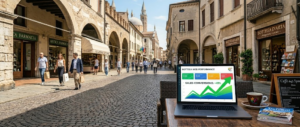
[PICTURE PROMPT: A wide-angle, beautiful photograph of a busy cobblestone street in the Centro Storico of Padova, with local shoppers walking past historic storefronts. In the foreground, a professional computer laptop sits on an outdoor café table, displaying a colorful website performance dashboard with an arrow showing an upward trend in sales conversions.]
If your website actively receives visitors every week but those people leave without filling out your form, calling your shop, or completing a purchase, you are effectively pouring water into a leaky bucket. You are leaving real money on the table.
Conversion Rate Optimization (CRO) is simply the practical art and science of turning those existing, passive website browsers into active, paying customers. For small businesses across Padova, the goal is not to continuously bleed cash on aggressive Facebook or Google ad campaigns. Instead, it is about spending smarter by maximizing the layout, speed, and messaging of your digital storefront so that you wring the maximum amount of revenue out of every single click you already earn.
1. The Real Cost of a Leaky Website Funnel
To understand why optimizing your website matters, we have to look past abstract marketing jargon and examine how real people in Padova behave online. Imagine you run a localized boutique law firm or a specialized accounting practice (commercialista) near the Tribunale di Padova. You decide to run a Google Ads campaign targeting local business owners who need immediate corporate tax assistance.
You pay 2.50 Euros for every single click. Over the course of a month, 1,000 targeted Padova residents click your ad and land on your website. This means you have spent 2,500 Euros just to get people through your digital front door.
Now, let’s look at two completely different scenarios based on how well that website is optimized to convert those visitors:
Scenario A: The Unoptimized Website
Your website takes five seconds to load on a mobile phone. The main headline says “Welcome to our prestigious firm founded in 1998,” which doesn’t tell the visitor how you can help them today. To get a consultation, the user has to click through three different pages to find a contact form that demands fourteen different fields of text, including their certified email (PEC) and company registration number (Partita IVA).
Frustrated by the friction, 995 of those visitors close the tab and look for an easier option. Only 5 people manage to finish the form. Your conversion rate is a meager 0.5%, and each lead has cost you a staggering 500 Euros in ad spend.
Scenario B: The Optimized Website
The exact same 1,000 people click your ads, but this time they land on a page optimized for human behavior. The site snaps open instantly on smartphones. The headline immediately addresses their problem: “Struggling with corporate tax deadlines in Veneto? Our Padova-based team handles the paperwork so you can focus on growth.”
Right below the headline is a prominent, bright button that says, “Schedule a 15-minute call over WhatsApp.” The form is a single column requiring only a name, email, and phone number.
Because you removed the roadblocks, 40 people reach out to you. Your conversion rate climbs to a healthy 4%, and your cost per lead drops from 500 Euros down to just 62.50 Euros. You haven’t spent an extra cent on advertising; you simply fixed the leaks in the funnel you already paid to build.
2. The CRO Mindset: Why Small Local Businesses Hold the Advantage
When small business owners first hear about Conversion Rate Optimization, they often get intimidated because they think it requires the multi-million euro budgets, massive data science departments, and complex automated A/B testing software used by global giants like Amazon, Booking.com, or Zalando. This assumption is completely wrong.
As an independent business owner in Padova, you possess a massive, unfair competitive advantage that no international corporation can copy: genuine proximity to your customer.
[PICTURE PROMPT: A warm, authentic close-up shot of a local Italian artisan business owner in their workshop in Padova, smiling and interacting with a customer. The scene exudes trust, local heritage, and personal connection, contrasting sharply with cold corporate environments.]
In the Italian market, and particularly within the Veneto region, business is deeply personal. Commerce is built on a foundation of long-term trust, local reputation, shared identity, and face-to-face relationships. A consumer or business buyer in Padova would almost always prefer to support a dedicated local expert over a faceless, distant corporation—provided that the local expert can prove they are professional, competent, and easy to do business with.
Large corporations have to use complex statistical software because they are trying to appeal to millions of completely different people across different continents simultaneously. They are searching for generic, mathematical averages.
You, on the other hand, know exactly who your audience is. You know the exact neighborhoods they live in, from Arcella to Guizza. You know the exact local regulations your corporate clients face in the province of Padova. You know the precise cultural nuances and lifestyle preferences of a Veneto shopper.
CRO for a small business isn’t about playing complex mathematical games with software; it is about using your local knowledge to remove digital barriers so that your natural warmth, expertise, and authority can shine through clearly.
3. The Technical Audit: Fixing Speed Roadblocks
Before you spend a single Euro on marketing strategies or creative copywriting, you must ensure that your website’s technical infrastructure isn’t actively driving users away. In the modern digital landscape, speed is the ultimate currency of trust. We live in an era of instant gratification.
If a local resident clicks your link while riding the tram past Prato della Valle and your website takes more than three seconds to display its content, that user will hit the back button before your logo even finishes rendering. They won’t wait around out of politeness; they will simply jump straight into the arms of a competitor whose site loads instantly.
[PICTURE PROMPT: A high-quality graphic showcasing a modern smartphone screen running the Google PageSpeed Insights tool, displaying a bright green score of 95/100, symbolizing an incredibly fast, technically optimized local business website.]
Slow loading times send a subtle, damaging psychological signal to your audience. If your business cannot bother to maintain a fast, modern, and functional website, a prospective customer will naturally wonder if your physical services are just as slow, outdated, and neglected. To fix these technical conversion drains, follow this direct optimization checklist:
Compress Your Visual Media
The single biggest cause of slow websites in Padova is uncompressed imagery. Local business owners often upload beautiful, high-resolution photographs taken directly from a professional DSLR camera or a modern smartphone straight onto their WordPress media library. These file sizes are frequently 5MB to 10MB each.
Use free compression tools like TinyPNG or modern image formats like WebP to shrink those files down to under 150KB without losing any visible visual quality.
Simplify Your Hosting and Caching
Many small businesses run their websites on cheap, crowded international shared hosting plans that cost two euros a month, resulting in terrible server response times within Italy. Switch your site to a hosting provider with physical servers located in Italy or Western Europe.
Implement a robust, free caching plugin like WP Rocket or LiteSpeed Cache so that your website files are pre-built and saved on the user’s browser, allowing pages to load in the blink of an eye upon repeat visits.
Clean the Code Junk
Over time, websites built on platforms like Elementor or standard WordPress themes accumulate a massive amount of technical clutter—unused plugins, redundant CSS stylesheets, and heavy JavaScript files that load in the background. Go through your backend dashboard and permanently delete every single plugin that is not absolutely vital to your day-to-day business operations. Clean code means a fast user experience, and a fast user experience keeps people on your page long enough to convert.
4. Designing a Mobile-First UX for the Busy Padova Resident
Take a moment to look around you the next time you are walking through the Piazza dei Signori or sitting down for an aperitivo. Nearly every single person has a smartphone in their hand or within arm’s reach.
Over 65% of all local web searches across the province of Padova are conducted on mobile devices. Whether someone is looking for an emergency locksmith (fabbro) late at night or searching for a top-tier catering service for a corporate event while commuting, they are browsing your business through a five-inch glass screen.
Despite this undeniable reality, the vast majority of small business websites are designed, reviewed, and approved on large, 27-inch desktop monitors in comfortable offices. This creates a massive disconnect. A layout that looks gorgeous, spacious, and elegant on a designer’s wide desktop screen frequently turns into an absolute structural nightmare when squeezed onto a mobile phone.
To optimize your conversion rates, you must adopt a strict mobile-first design methodology. This means prioritizing the smartphone user experience above everything else. Open your business website on your personal mobile phone right now and run it through this simple usability test:
-
The Three-Second Thumb Test: Can you easily find your core contact button or checkout link within three seconds of the page loading? Is that button placed prominently in the center or lower third of the screen where a user’s thumb naturally rests while holding a phone with one hand? If a user has to stretch their hand or use two fingers just to tap your menu, your layout is losing you sales.
-
Text and Button Targets: Are your content fonts large enough to be read comfortably under bright sunlight without zooming in? Are your buttons spaced far enough apart so that someone with larger hands won’t accidentally tap the wrong link? Your interactive buttons should have a minimum target size of 48×48 pixels with clear visual padding around them.
-
The Fixed Sticky Footer: For local service providers, implementing a “sticky” mobile navigation bar that stays locked to the bottom of the screen as the user scrolls down the page is an absolute game-changer for conversion rates. This footer should feature two simple buttons: one to call your office phone directly, and one to launch a live WhatsApp conversation. By keeping the primary action steps permanently visible, you remove the effort of hunting for a contact page, making it incredibly easy for a hot lead to get in touch the exact moment they decide they like your work.
5. Streamlining Forms: Eradicating the Silent Conversion Killer
Nothing kills a conversion faster than an exhausting, invasive, and poorly formatted online input form. Imagine a local business executive who is exhausted after a long day of meetings in the Zona Industriale. They find your specialized consulting website and decide they want to request a corporate service quote. They click your “Request a Proposal” button, only to be confronted by a massive digital wall of text fields.
[PICTURE PROMPT: A stark, high-contrast side-by-side comparison diagram. On the left, a red 'X' marks a messy, overwhelming multi-column website form with 15 fields demanding private corporate data. On the right, a bright green checkmark highlights a sleek, single-column form with just 3 clean fields: Name, Email, and Phone Number.]
Your form demands their full first name, last name, home address, company fiscal code, secondary phone number, fax number, number of employees, annual revenue bracket, and a mandatory 500-word text box explaining their entire business background.
What happens next? The executive sighs, closes the browser tab, and goes to a competitor whose form takes five seconds to fill out. You didn’t just lose a lead; you actively pushed a high-value customer away through poor design.
Every single unnecessary text field you include in a web form acts as an independent point of friction that reduces your overall conversion rates. A classic marketing study by HubSpot analyzed over 40,000 landing page forms and discovered that reducing the number of form fields from four down to three resulted in an immediate 50% average increase in total conversions.
To optimize your contact forms, apply a ruthless minimalist philosophy:
-
Ask Only for the Absolute Essentials: What do you genuinely need to know about a prospect to start a polite follow-up conversation? In 90% of local business cases, you only need three basic pieces of data: their first name, their direct email address, and their phone number. You do not need their full business history, street address, or tax details just to schedule an introductory phone call. You can easily gather that background info later once they are a warm lead talking to you over the phone or sitting across from your desk.
-
Use a Single-Column Layout: Multi-column forms (where inputs are placed side-by-side) confuse the human eye and disrupt the natural downward scrolling motion on mobile screens. Keep all your fields stacked neatly in a single, clean vertical line.
-
Enable Smart Autofill Attributes: Ensure your website’s code uses correct HTML tags so that browsers can automatically fill in the user’s name, email, and phone number with a single tap. The less typing a user has to do on a mobile keyboard, the higher your chances of securing their business.
6. Crafting an Irresistible Local Value Proposition
When a local resident lands on your website’s homepage or dedicated landing page, a mental clock starts ticking inside their head. You have roughly five seconds to capture their attention and convince them to stay before they get bored and look elsewhere.
During those critical five seconds, the user needs to find clear, immediate answers to three fundamental questions:
-
What specific product or service do you offer?
-
How will this solve my problem or make my life better?
-
What do I need to do next to buy it or get started?
Unfortunately, if you browse most small business websites in Padova today, you will find that their primary, top-of-page real estate is completely wasted on empty, generic clichés. They feature massive headlines like “Welcome to Our Website,” “We Are the Leaders in Quality,” or “Innovative Solutions for Modern Demands.”
These phrases are completely meaningless to a real person. They don’t offer value, they don’t address a pain point, and they do absolutely nothing to distinguish your local shop from an international online alternative.
[PICTURE PROMPT: A professional, close-up photograph of a modern desktop computer monitor displaying a beautifully optimized landing page for a Padova business. The headline is bold and clear: 'Pronto Intervento Idraulico a Padova - Attivi 24/7 nelle Zone di Arcella, Guizza e Centro Storico', showing immediate local relevance.]
To optimize your conversions, you must replace these vague platitudes with a sharp, benefit-driven, and highly localized value proposition. Let’s look at how to transform generic corporate phrasing into high-converting, human-centric copy for different local business sectors:
Local Medical or Dental Clinic
-
The Bad AI Headline: “We offer premium medical excellence and healthcare services utilizing state-of-the-art diagnostic paradigms for local patients.”
-
The Better Human Headline: “No more long waiting lists. Book an appointment this week with our friendly, English-speaking dental team in the center of Padova.”
Artisanal B2C Retailer (e.g., Handmade Furniture or Fashion)
-
The Bad AI Headline: “Synergizing authentic Italian heritage with manufacturing paradigms to deliver superior product optimization.”
-
The Better Human Headline: “Handcrafted solid wood dining tables, custom-made in our Padova workshop. Designed to bring your family together for generations. Free delivery across the Veneto region.”
Specialized B2B Service (e.g., Industrial Logistics or Mechanical components)
-
The Bad AI Headline: “Leveraging global logistics supply chain frameworks to maximize institutional corporate efficiency parameters.”
-
The Better Human Headline: “Zero delayed shipments. We provide reliable, same-day industrial courier and logistics services across the Padova Zona Industriale (ZIP).”
Notice the clear pattern: the optimized headlines drop the complicated buzzwords and use simple, everyday language. They address the core human desires—saving time, avoiding frustration, getting reliable local support—and explicitly state your physical presence in Padova to build instant geographic trust.
7. The Power of “The Padova Factor”: Building Bulletproof Social Proof
In a sophisticated, interconnected marketplace like Padova, consumers do not trust what a business says about itself in its own marketing copy. They know that anyone can write that they are “the best” or “the most professional” on their own website. To break down the natural walls of skepticism that every online browser holds, you need to display robust, undeniable social proof—the verified voices of real, local people who have already spent their hard-earned money with your company and had a fantastic experience.
However, standard, generic testimonials are no longer enough. If your website features a section with text that reads: “Great service, highly recommended! – Giovanni B.”, your visitors will assume you fabricated it yourself. To make your social proof convert like crazy, you need to make it feel deeply authentic, highly specific, and grounded in the local community. We call this leveraging The Padova Factor:
-
Integrate Live Google Business Profile Reviews: Instead of manually typing out text testimonials onto your pages, use a simple, secure plugin to stream your real Google reviews directly onto your site. This allows visitors to see the real names, profile pictures, and active local reviewer statuses of your past clients, proving beyond a shadow of a doubt that the feedback is 100% genuine.
-
Highlight Neighborhood Relevance: When you showcase a customer success story or case study, include local geographic context. If you are an interior designer or a renovation contractor, don’t just say you renovated an apartment. Frame it like this: “A complete modern apartment renovation for a family in the heart of Arcella, Padova.” This subtle addition signals to neighboring residents that you are intimately familiar with local building styles, community rules, and regional property trends.
-
Show Local Faces and Your Real Storefront: Avoid cold, artificial international corporate stock photos at all costs. If a local resident lands on a Padova attorney’s website and sees a generic photograph of American models in a corporate skyscraper, they instantly disconnect. Replace those fake images with authentic, high-quality photographs of your real team smiling in your physical office or standing outside your brick-and-mortar storefront in the city center. When a visitor recognizes the local streets or sees the warm, real faces of the professionals they will be meeting in person, their trust sky-rockets, and their hesitation to reach out melts away.
8. Low-Cost behavioral Analytics: Seeing Your Site Through Your Users’ Eyes
One of the biggest traps business owners fall into when trying to optimize their website is relying entirely on personal guesswork or the subjective design opinions of friends and family. You might look at your homepage and think the layout looks beautiful, but your personal opinion doesn’t pay the bills. To make data-driven improvements that genuinely boost your sales, you need to watch exactly how real, anonymous users interact with your digital storefront in real-time.
[PICTURE PROMPT: A close-up view of a tablet screen displaying a vivid website heatmap analysis from Microsoft Clarity. The screen shows red hot-spots concentrated intensely around a main call-to-action button, while showing large blue cold-spots over long blocks of unread corporate text, showing where real users actually focus their attention.]
Thankfully, you don’t need a massive enterprise budget to access elite user-behavior tracking tools. Platforms like Microsoft Clarity are 100% free to use forever and take less than five minutes to install on your website via Google Tag Manager. These behavioral analytics tools provide two invaluable features that expose exactly where your website is losing customers:
Visual Heatmaps
Heatmaps provide an instant, color-coded map of where users click, scroll, and focus their attention on your pages. Red “hot spots” indicate sections where users are actively clicking, while blue “cold zones” show parts of your site that are being completely ignored.
If you discover that users are consistently scrolling past your long, wordy paragraphs about corporate philosophy but are heavily clicking a small image of a product, you can immediately reposition your primary contact buttons to sit right next to that high-interest image.
Identifying User Frustration (Rage Clicking)
This is one of the most powerful diagnostic features of modern CRO software. The system automatically tracks and flags moments where a user performs a “rage click.” This happens when an online visitor gets deeply frustrated and taps their mouse or mobile screen repeatedly on a specific element because they expect it to do something, but it remains unresponsive.
For example, you might have a graphic or an icon on your page that looks like a clickable button, but it’s actually just a static image. When you see real-world recordings of local clients rage-clicking that element and then leaving your site out of annoyance, you can immediately fix the issue by turning that graphic into a working link that goes straight to your booking form. Watching real user recordings takes the guesswork out of website design, allowing you to make small, surgical adjustments that directly result in higher conversion rates.
9. The 8-Week Step-by-Step Small Business CRO Roadmap
Optimizing your website for conversion rates should not be treated as a chaotic, overwhelming weekend sprint that disrupts your daily business operations. Instead, think of it as a calm, systematic, and continuous journey of small, manageable improvements. By dedicating just a couple of hours every single week to a specific, focused task, you can completely transform your website into a high-performance sales machine over the course of two months.
Follow this structured roadmap designed to keep your implementation simple, affordable, and highly effective:
<Timeline>
{/* Reason: A chronological roadmap allows a small business owner to see exactly how to execute a CRO strategy step-by-step over 8 weeks without getting overwhelmed. */}
  <TimelineEvent title="Technical Performance and Speed Audit" time="Weeks 1 - 2">
    Run your website through Google PageSpeed Insights. Compress every single image file down to under 150KB using free online tools, set up an Italian-localized hosting infrastructure, and clear out all your unused background WordPress plugins to ensure your pages snap open instantly on local mobile connections.
  </TimelineEvent>
  <TimelineEvent title="Mobile UX and Navigation Optimization" time="Weeks 3 - 4">
    Review your website extensively on a real smartphone screen. Redesign your main navigation menus to be completely thumb-friendly, ensure your font sizes are highly legible under direct sunlight, and implement a fixed, sticky mobile footer featuring direct call and WhatsApp chat links for immediate local access.
  </TimelineEvent>
  <TimelineEvent title="Value Proposition and Copywriting Overhaul" time="Weeks 5 - 6">
    Rewrite your top-of-page headlines to remove vague corporate jargon. Replace them with clear, benefit-focused language that explicitly states your services and addresses your target Padova audience. Remove half of the text fields from your contact forms, turning them into a clean, single-column layout that takes seconds to complete.
  </TimelineEvent>
  <TimelineEvent title="Social Proof and Behavioral Analytics Deployment" time="Weeks 7 - 8">
    Integrate a live Google Business Profile widget to stream your authentic 5-star customer reviews. Replace all corporate stock photography with real photos of your local team and storefront. Install the free Microsoft Clarity tracking script to analyze visual heatmaps, identify user frustration points, and lock in continuous sales growth.
  </TimelineEvent>
</Timeline>
10. Critical Mistakes That Local Businesses Must Avoid
As you begin optimizing your website for higher conversion rates, it is vital to remember that doing less, but doing it exceptionally well, will always outperform a chaotic design strategy. It is incredibly easy for independent business owners to get over-excited, over-complicate their web design, and accidentally make their user experience significantly worse.
To keep your digital storefront performing at its absolute peak, keep a watchful eye out for these three common, costly CRO pitfalls:
-
Don’t Fall into the Trap of Over-Testing: If your website is a localized service or niche boutique that receives less than 2,000 unique visitors per month, do not waste your valuable time running complex, micro-level statistical A/B split tests (like testing whether a button performs better as sky blue versus navy blue). A website requires tens of thousands of monthly clicks to gather statistically valid data for micro-tests. Instead, focus all your energy on fixing big, glaring, common-sense usability issues: make your site faster, clarify your core messaging, and fix broken layout links.
-
Never Let Third-Party Pop-ups Destroy the User Experience: We have all experienced the deep irritation of landing on a website only to be instantly blinded by three different overlapping pop-up windows: an aggressive newsletter signup box, a flashing promotional discount banner, and a giant live-chat widget that emits a loud chime. When these heavy widgets load simultaneously on a smartphone, they freeze the user’s screen, hide your main content, and cause immediate frustration. Keep your mobile interface completely clean, minimalist, and easy to read.
-
Don’t Ignore Your Ongoing Local Compliance Standards: In Italy, data privacy is a serious matter. As you add analytics codes, conversion trackers, or behavioral recording scripts like Microsoft Clarity to your website, you must ensure that your Italian privacy policy and cookie consent banners are fully configured to block these tracking scripts until the user gives explicit permission. Partnering with localized legal compliance platforms like Iubenda ensures that your website remains completely safe from steep regulatory fines while you quietly optimize your business growth.
11. The Ultimate Website Conversion Checklist for Padova Businesses
To ensure your digital presence is completely optimized to capture every drop of local interest, take thirty minutes this week to audit your website against this definitive conversion checklist. If you find a section where your site falls short, prioritize it during your next weekly optimization block.
[PICTURE PROMPT: A clean, modern clipboard graphic resting on a minimalist wooden desk. The clipboard holds a checklist with distinct boxes checked off with a green pen next to titles written in clean Italian typography, symbolizing a completed website conversion rate audit.]
🏎️ Technical Performance & Speed
-
[ ] The website loads completely in less than 3 seconds on a standard 4G mobile connection.
-
[ ] All images have been compressed to under 150KB and converted to modern formats like WebP.
-
[ ] The website hosting server is physically located in Italy or Western Europe to ensure fast response times.
-
[ ] All unused background WordPress plugins have been permanently deactivated and deleted.
📱 Smartphone Usability (Mobile-First UX)
-
[ ] The primary call-to-action button is visible within the first 3 seconds of loading without scrolling.
-
[ ] All buttons have a minimum size of 48×48 pixels and are easily clickable with a thumb.
-
[ ] The font sizes are large enough to read comfortably on a mobile screen without manual zooming.
-
[ ] A fixed sticky footer is active on mobile, providing immediate links to call or launch WhatsApp.
✍️ Copywriting & Trust Factors
-
[ ] The main headline clearly states what the business does and who it serves using zero corporate clichés.
-
[ ] The copy explicitly mentions the physical location (Padova, specific neighborhoods, or the Veneto region).
-
[ ] Real photographs of the local team and physical storefront are used instead of generic stock photos.
-
[ ] Live Google Business Profile reviews are streamed directly onto the core landing pages.
📉 Friction Reduction & Data
-
[ ] All contact and inquiry forms have been reduced to the absolute minimum necessary fields (Name, Email, Phone).
-
[ ] Contact forms are built in a clean, single-column layout for smooth vertical scrolling.
-
[ ] Free behavioral analytics tracking (like Microsoft Clarity) is active to monitor heatmaps and user frustration.
-
[ ] Tracking pixels are legally tied to a compliant cookie consent banner powered by a platform like Iubenda.
By methodically addressing these foundational technical, structural, and text-based elements, your local business can transform its website from a passive online brochure into an elite digital sales platform that consistently converts local browsers into long-term, loyal clients.