
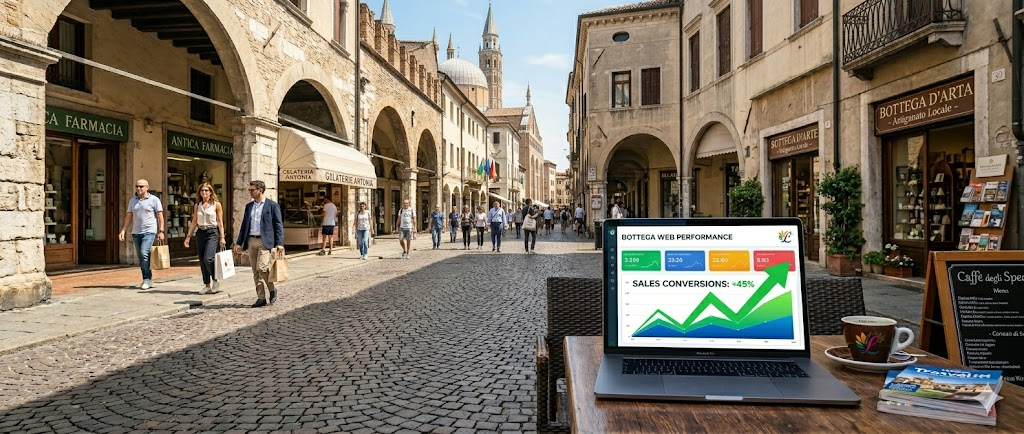
Padova (Padua) is a city of incredible contrasts. On one side, you have centuries of rich history, deep-rooted academic traditions at the Università di Padova, and the breathtaking, UNESCO-protected Giotto frescoes in the Scrovegni Chapel. On the other side, just a few kilometers away, you find the rapid-fire pulse of modern industrial engineering in the Zona Industriale (ZIP), one of the densest manufacturing hubs in Europe.
For a small business owner trying to make a name for themselves here in 2026, standard, cookie-cutter marketing playbooks simply will not work. What works for a trendy boutique in Milan or a tech startup in Rome will fall flat in Padova.
Whether you are trying to land a high-value B2B contract with a mechanical parts manufacturer out east or trying to get students and locals to step into your café near Piazza delle Erbe, you need a strategy tailored specifically to this unique Venetian market.
[IMAGE PLACEHOLDER: A split-screen or high-contrast hero photograph showing the historic Prato della Valle on one side and a modern, high-tech automated manufacturing floor or office building in Padova’s Zona Industriale on the other, capturing the dual essence of the city.]
This comprehensive, highly practical guide is designed to help local businesses master the art and science of local brand awareness. We will show you how to ensure that every single Euro you spend translates into real, measurable local growth—all without burning through your hard-earned savings.
1. The Padova Economic Landscape: Mapping Out Your Local Opportunities
To build real awareness, you have to realize that Padova’s economy is divided into distinct micro-markets. You cannot treat a customer in the historic city center the same way you treat a purchasing manager in the industrial zone. Let’s break down the three core areas where your business can find its footing.
A. The Industrial Heartland: Navigating the ZIP (Zona Industriale Padova)
The ZIP is a massive engine driving the Veneto region’s economy. It is packed with metalworking shops, logistics firms, automation experts, and packaging companies. If you sell B2B services, industrial supplies, software, corporate catering, or commercial cleaning, this is your goldmine.
- The Reality Check: Decision-makers in the ZIP do not care about viral TikTok videos, flashy Instagram reels, or abstract lifestyle branding. They care about reliability, certified quality, speed, and technical competence.
- The Low-Cost Strategy: Shift your focus from “broad visibility” to “niche authority.” Instead of spending money on broad Facebook ads, invest time in creating a highly detailed case study or a short technical guide. For example, if you run a local commercial commercial cleaning service, don’t just say “we clean offices.” Create a short PDF titled: “How Padova Manufacturing Plants Minimize Assembly Line Downtime Through Scheduled Facility Maintenance.”
- The Human Touch: Share that guide directly with plant managers in Padova via personalized LinkedIn messages or drop off a printed copy during a quick, professional introductory visit. In this sector, building relationships through shared technical expertise is the most cost-effective way to get noticed.
B. The Historic & Retail Hub: Dominating the Centro Storico
The Centro Storico—including the bustling areas around Piazza dei Signori, Piazza della Frutta, and the Jewish Ghetto—is the lifeblood of Padova’s retail, fashion, hospitality, and artisan culture.
[IMAGE PLACEHOLDER: A warm, inviting photograph of a lively pedestrian street in Padova’s Centro Storico, featuring an independent clothing boutique or an artisanal bakery with locals browsing outside under historic arcades.]
- The Reality Check: Here, competition is fierce, and rent is expensive. You aren’t just competing with the shop next door; you are competing with big global brands and the sheer volume of noise in a crowded city center.
- The Low-Cost Strategy: Your goal is hyper-local digital dominance. This means making sure your business shows up on a smartphone screen the exact second a local resident or a tourist searches for what you offer. If you run an artisanal bakery or a boutique clothing store, your absolute best friend is local Search Engine Optimization (SEO) and creative visual storytelling.
- The Human Touch: Use Instagram and Facebook not just to post boring pictures of your products, but to show the human faces behind the counter. Film a quick 30-second video of your head baker pulling fresh pasticceria out of the oven at 6:00 AM, or talk about why you sourced a specific linen fabric from a weaver right here in the Veneto region.
C. The Academic & Startup Corridor: Engaging the Università and Beyond
With over 60,000 students, the Università di Padova injects a massive wave of youthful energy, innovation, and digital-native consumer habits into the city. This zone stretches across the historic university buildings, the Portello district, and the modern co-working spaces and tech incubators popping up around the city.
- The Reality Check: This audience has zero tolerance for clunky websites, outdated payment methods, or corporate talk. They are highly connected, socially conscious, and expect completely frictionless interactions with brands.
- The Low-Cost Strategy: Focus on digital accessibility, interactive content, and genuine community alignment. If you offer a service—like a local language school, a co-working space, a repair shop, or a fitness studio—don’t just give them a static “Contact Us” form to fill out. Give them something interactive.
- The Human Touch: Create a quick online quiz or a simple tool, such as an interactive map of the best quiet study spots in Padova that happens to feature your café at the top of the list. Partner with student associations (associazioni studentesche) or offer genuine, non-gimmicky student discounts that respect their tight budgets.
2. Setting Up a Bulletproof Digital and Data Infrastructure
Many small business owners make the mistake of launching creative marketing campaigns before fixing their basic digital setup. If your website is slow, confusing, or fails to properly track visitors, every Euro you spend on marketing is essentially being thrown out the window.
Think of your data infrastructure as the invisible foundation of a building. If the foundation is cracked, it doesn’t matter how beautiful the storefront looks.
A. Mastering Privacy and Consent Mode V2 in Italy
Europe, and Italy in particular, has some of the strictest data privacy laws in the world under GDPR. You cannot simply drop tracking cookies onto a visitor’s browser without their explicit permission. Doing so risks massive fines and destroys trust with local customers who highly value their privacy.
- What it means for you: By 2026, Google requires all businesses running digital ads to fully implement Google Consent Mode V2. This is a technical setup that adjusts how your tracking tags behave based on whether a website visitor clicks “Accept” or “Decline” on your cookie banner.
- The Affordable Workaround: If a user clicks “Decline,” you lose their direct tracking data. However, with Consent Mode V2 properly installed, Google’s advanced AI systems can use “behavioral modeling” to fill in the blanks anonymously. This allows you to safely recover a significant portion of your lost campaign data without violating any privacy laws or spending extra money on expensive analytical software.
B. Moving to Server-Side Tracking to Reclaim Your Data
Traditional digital marketing relies on browser-based tracking pixels (like the Meta Pixel or Google Analytics tags installed directly on your website code). The problem? Modern ad-blockers, privacy-focused browsers like Safari and Brave, and strict device settings routinely block these pixels.
[IMAGE PLACEHOLDER: A clean, easy-to-understand diagram contrasting traditional browser-based tracking (where data is blocked by the user’s browser) with modern Server-Side Tracking (where data flows securely from the website to a private cloud server before reaching ad platforms like Meta and Google).]
- The Solution: Small businesses need to look into Server-Side Google Tag Manager (GTM). Instead of sending data directly from the customer’s web browser to Meta or Google, the data is sent securely to a cloud server that you control. From that server, the data is routed to the advertising platforms.
- Why it saves you money: Server-side tracking bypasses most standard ad-blockers. This ensures that your Meta and Google ad accounts receive 100% of your customer conversion signals. When your ad platform actually sees who is buying from you, its algorithm becomes much smarter, lowering your overall cost-per-click and making your small ad budget stretch much further.
C. Integrating Your CRM and the Vital “Five-Minute Rule”
A Customer Relationship Management (CRM) system sounds like a tool only meant for massive corporations, but it is entirely essential for a small business in Padova. Free or highly affordable tools like HubSpot, Zoho, or even a meticulously organized, automated Google Sheet via Zapier can serve as your CRM.
- The Golden Rule of Inbound Leads: When a local customer fills out a contact form on your website asking for a quote or an appointment, the clock starts ticking immediately.
- The Data: Study after study shows that if you follow up with a lead within five minutes of their submission, your chances of converting them into a paying customer increase by more than 80% compared to waiting even an hour.
- Action Step: Set up instant automated email notifications or SMS alerts on your phone through your CRM. If a local restaurant manager inquires about your fresh produce delivery service or your web design services, call or message them immediately. In a traditional market like Padova, this level of lightning-fast professionalism instantly sets you apart from slower competitors.
3. Finding Your Creative Edge: How to Craft Messages That Connect
Once your digital foundation is solid, you need to think about what you are actually saying to your audience. The Italian market place a massive premium on style, tone, and reputation. To cut through the noise, your messaging needs to feel intensely relevant, deeply empathetic, and undeniably authentic.
A. Securing the Perfect Message-Market Fit
A common marketing mistake is running an ad with one message, but sending people to a website page that says something completely different. This mismatch confuses visitors and makes them leave your site instantly.
- A Real Padova Example: Let’s say you run a local boutique accounting and tax advisory firm (commercialista) specialized in helping new freelancers and artisans set up their businesses. You run a local Facebook ad with the headline: “Guida Pratica: Come Aprire la Partita IVA a Padova nel 2026 Senza Errori” (Practical Guide: How to Open a Partita IVA in Padova in 2026 Without Mistakes).
- The Mistake: When a user clicks the ad, they are taken to your generic homepage that lists corporate tax restructuring, auditing, and corporate mergers. The user instantly feels like they are in the wrong place and clicks away.
- The Fix: Send them to a simple, dedicated landing page that features the exact same headline as your ad, along with a clean bulleted list of tips specifically written for small local freelancers. This perfect “message match” reassures the visitor that they are in exactly the right place, drastically improving your registration rates.
B. Shifting to Benefit-Driven, Problem-Solving Copywriting
Stop describing what your business is, and start describing what your business does to make your customer’s life easier or more profitable. Customers do not buy features; they buy solutions to their immediate headaches.
Let’s look at how we can rewrite standard business descriptions into highly compelling, benefit-driven local copy:
| Business Type | Feature-Driven Copy (What We Do) | Benefit-Driven Copy (How We Help You) |
| Local Machine Shop (ZIP) | “We provide state-of-the-art CNC milling and metal machining services.” | “Eliminate supply chain delays. Get precision-machined components built strictly to Padova’s industrial standards, delivered on time.” |
| Co-working Space (Portello) | “We have 20 desks, high-speed fiber internet, and a shared kitchen area.” | “Escape the distractions of home. Work in a quiet, high-speed space designed for Padova’s freelancers, complete with unlimited artisanal coffee.” |
| Residential Solar Installer | “We install 620-watt hybrid solar panel systems with lithium backup batteries.” | “Slash your monthly Italian energy bills. Protect your family home from local grid outages with a smart, compact solar setup.” |
C. Harnessing Local Social Proof and Authority
In a close-knit region like Veneto, trust is the ultimate currency. People want to know who you have worked with and what your reputation is before they take a risk on a new business.
[IMAGE PLACEHOLDER: A professional, close-up photograph of a local business owner standing proudly in front of their workshop or office in Padova, smiling warmly at the camera, representing authentic local customer satisfaction.]
- Showcase Local Logos: If you are a B2B company, display the logos of recognized local firms or trade organizations you belong to (like Confindustria or Confartigianato Padova) prominently on your website.
- Ditch Text Testimonials for Short Videos: A written review can easily be faked. A 45-second video filmed on a smartphone showing a local customer standing in their actual shop in Padova, talking about how your service saved them time or money, is completely undeniable.
- Highlight Local Context: When sharing a review, don’t just list the person’s name. Use local identifiers: “Marco R., Owner of a historic trattoria near Prato della Valle.” This anchors your credibility deep within the local community.
4. The Street-Level, High-Impact Community Strategy
Digital ads are fantastic, but for a small business operating on a limited budget, some of your highest-yielding awareness campaigns will happen completely away from a computer screen. Padova is a compact, highly walkable city where word-of-mouth still carries incredible power.
A. Forging Strategic Local Cross-Promotions
Look around your neighborhood for businesses that share your ideal target audience but are not your direct competitors. By partnering with them, you can gain direct access to their customer base for absolutely zero cost.
- The Concept in Action: Imagine you own a boutique specialty coffee shop in the Centro Storico. Just down the cobblestone street is an independent, locally owned bookstore.
- The Partnership: You can team up to launch a “Libri & Caffè” weekend promotion. Every customer who buys a book at the bookstore gets a voucher for a complimentary espresso at your café, and every customer who buys a premium pastry box at your shop gets a 10% discount coupon for the bookstore.
- Why it works: You are both trading high-quality, pre-verified local customers. It costs neither business any real money, builds immediate goodwill, and positions both of you as collaborative community champions.
B. Dominating Your Google Business Profile (GBP)
Your Google Business Profile (formerly Google My Business) is hands-down the most powerful, entirely free brand awareness tool available to any small business. When someone opens Google Maps on their phone and searches for “mechanical engineer near me,” “best pizza in Padova,” or “web designer,” the Map Pack results appear above standard web links.
[IMAGE PLACEHOLDER: A smartphone screen graphic displaying a pristine, fully optimized Google Business Profile for a local Padova business, showing a 5.0-star rating, clear operating hours, high-resolution interior photos, and a quick “Call” button.]
- Complete Every Single Field: Do not leave anything blank. Add your exact physical address, your precise service areas, your accurate opening hours, and a direct link to your website.
- Upload Fresh, Real Photos Weekly: Don’t use polished, fake corporate stock photos. Upload real, organic pictures of your storefront, your team at work, your latest project delivery, or your clean office space. Google’s algorithm loves active profiles, and customers love transparency.
- Build a Review Automation Habit: Never leave reviews to chance. Whenever you finish a successful project or complete a sale, send a friendly text or email with a direct link: “Grazie for choosing us! Would you mind taking 30 seconds to leave an honest review of your experience?”
- Always Reply: Respond to every single review within 48 hours. Thank the positive reviewers by name, and address any rare negative reviews with calm, professional, and helpful language. It proves to onlookers that your business is active, attentive, and deeply cares about its local reputation.
C. Thoughtful Community Sponsorships With High Returns
Sponsoring a massive city-wide event is far too expensive for a small business budget, but hyper-local, grassroots sponsorships are incredibly affordable and build deep emotional connections that digital banner ads simply cannot match.
- Think Small and Local: Look into sponsoring a neighborhood amateur sports team (società sportiva dilettantistica), a youth football league in Savonarola, a creative student design exhibition at the university, or a community park cleanup initiative.
- The Value Proposition: For a few hundred Euros, you can get your business logo printed on jerseys, featured on event banners, or mentioned in local neighborhood newsletters.
- The Lasting Impression: When parents see your small business supporting their children’s sports team, or when students see your brand funding their creative project, they don’t just remember your business name—they associate your brand with care, community support, and local pride. That level of emotional loyalty is incredibly difficult for large corporate competitors to disrupt.
5. Your 90-Day Step-by-Step Strategic Roadmap
Building brand awareness is a marathon, not a sprint. To avoid feeling overwhelmed, you need to break your marketing down into clear, manageable phases.
Here is an easy-to-follow, highly practical 90-day execution plan designed to get your Padova business noticed without draining your budget.
[IMAGE PLACEHOLDER: A clean, minimalist infographic timeline outlining a 90-day plan divided into three blocks: Weeks 1-4 (Foundations), Weeks 5-8 (Local Expansion), and Weeks 9-12 (Measurement & Optimization).]
Weeks 1–4: Building a Rock-Solid Foundation
This first month is all about clearing out the cobwebs, fixing technical issues, and sharpening your core message before you spend any money on advertising.
- Task 1: Claim, verify, and completely optimize your Google Business Profile. Add at least 15 high-quality, real photos of your team, products, or workspace.
- Task 2: Audit your website on a smartphone. Make sure it loads in under three seconds and that your contact forms are incredibly simple to fill out.
- Task 3: Write down your single most important customer benefit. Rewrite your website’s main headline to focus entirely on solving that specific customer problem.
- Task 4: Ensure Google Consent Mode V2 is correctly installed to safeguard your data tracking while respecting local privacy laws.
Weeks 5–8: Launching Your Local Expansion
With your foundation set, it’s time to step out into the light and start driving local traffic.
- Task 1: Approach two non-competing businesses in your neighborhood to pitch a simple, mutually beneficial cross-promotion or joint local event.
- Task 2: Launch a low-budget, hyper-targeted local ad campaign on Meta (Instagram/Facebook) or LinkedIn. Set the geographic target radius strictly to a 5-to-10 kilometer circle around your business or the ZIP zone.
- Task 3: Commit to posting two short, human-focused behind-the-scenes videos each week on your social channels, showing your actual work process.
- Task 4: Reach out to your top ten happiest past clients and personally ask them to leave an honest review on your Google Business Profile.
Weeks 9–12: Tracking, Measuring, and Optimizing
Now that your campaigns are live, you need to look at the numbers to see what is working and where you can cut out waste.
- Task 1: Open your Google Search Console account and check your Branded Search Volume. Are more people manually typing your exact business name into Google than they were two months ago? If yes, your brand awareness is growing.
- Task 2: Check your CRM or lead sheets. Calculate your average response time to new inquiries. Are you consistently hitting that vital five-minute follow-up window?
- Task 3: Analyze your digital ad spend. Identify which specific ad version or target audience yielded the lowest cost-per-lead, and shift your budget away from the low-performing versions into the winner.
- Task 4: Review the performance of your local business partnership. Count how many vouchers or coupons were actually redeemed, and discuss how you can improve the offer for the next quarter.
Conclusion: Turning Your Brand Awareness Into a Long-Term Asset
Building a highly respected, deeply recognized brand in Padova is a long-term project that requires consistency, local empathy, and data-backed precision. By treating your brand awareness as an ongoing business asset rather than a series of disconnected guessing games, you ensure your business stays resilient and top-of-mind.
The small businesses that thrive in Padova over the coming years will not be those with the largest advertising budgets. They will be the businesses that truly understand their local audience’s real problems, respect European data privacy standards, and masterfully blend digital tracking with authentic, human, street-level storytelling. Focus heavily on quality over quantity, show up consistently for your community, and watch your business take firm root in the region’s exciting economic growth.
Are you ready to map out your own custom local strategy? Brand building is an ongoing, iterative process. If you are currently dealing with low local recognition or finding it too expensive to acquire new clients, take an afternoon to review your current neighborhood touchpoints and see where the gaps lie.
Your Next Step to Local Visibility
If you found the frameworks in this 90-day roadmap useful, click below to walk through creating a highly customized, practical checklist designed to evaluate your current local search and community presence.