
What Is a Landing Page? The Complete 2026 Guide
A landing page is one of the smallest pieces of a marketing campaign and one of the most misunderstood. This guide answers what is a landing page, clears up the confusion with homepages, and walks through everything from design principles to real cost expectations — the exact questions people search before building their first one in 2026.
What Is a Landing Page, Exactly?
A landing page is a standalone web page built for a single purpose: getting a visitor to take one specific action, whether that’s signing up, requesting a quote, or making a purchase. Unlike a full website, it has no navigation menu pulling attention away, no competing links, and no distractions — everything on the page points toward that one conversion goal.
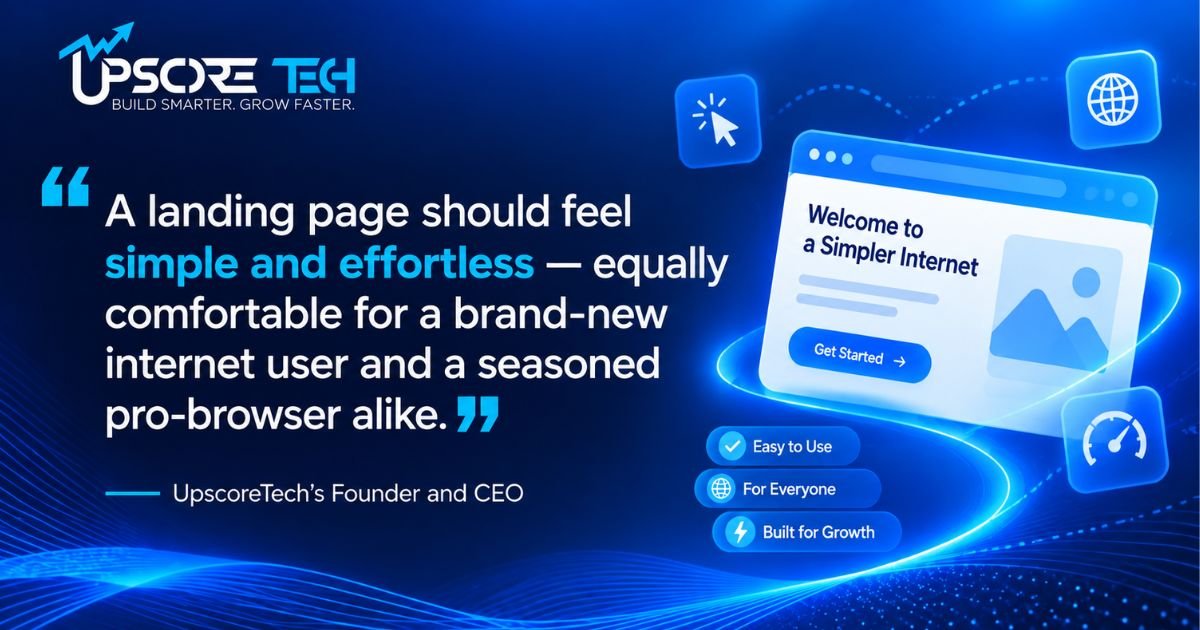
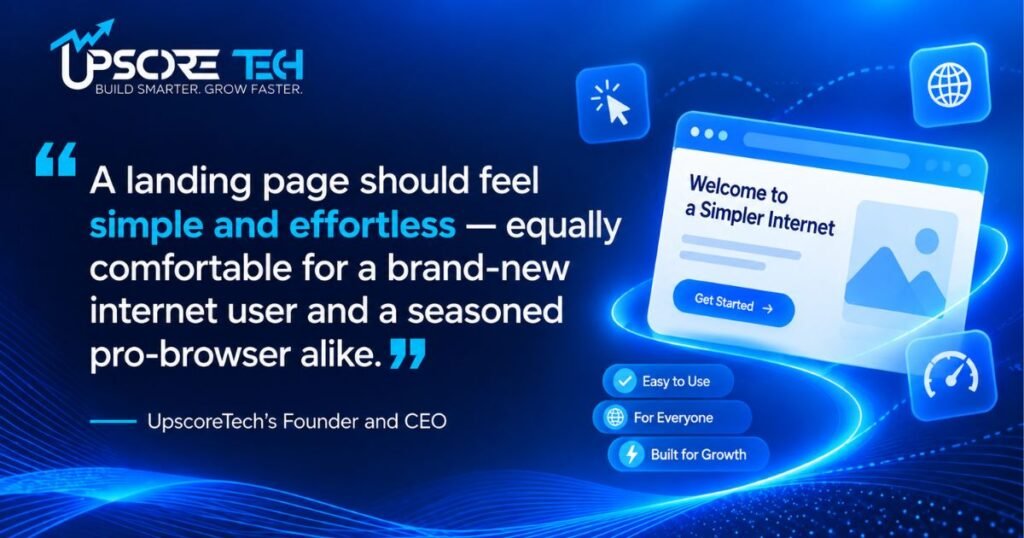
As UpscoreTech‘s Founder and CEO describes the standard we build toward: “A landing page should feel simple and effortless — equally comfortable for a brand-new internet user and a seasoned pro-browser alike.” That balance between simplicity and effectiveness is really the entire discipline in one sentence.
What’s the Difference Between a Landing Page and a Homepage?
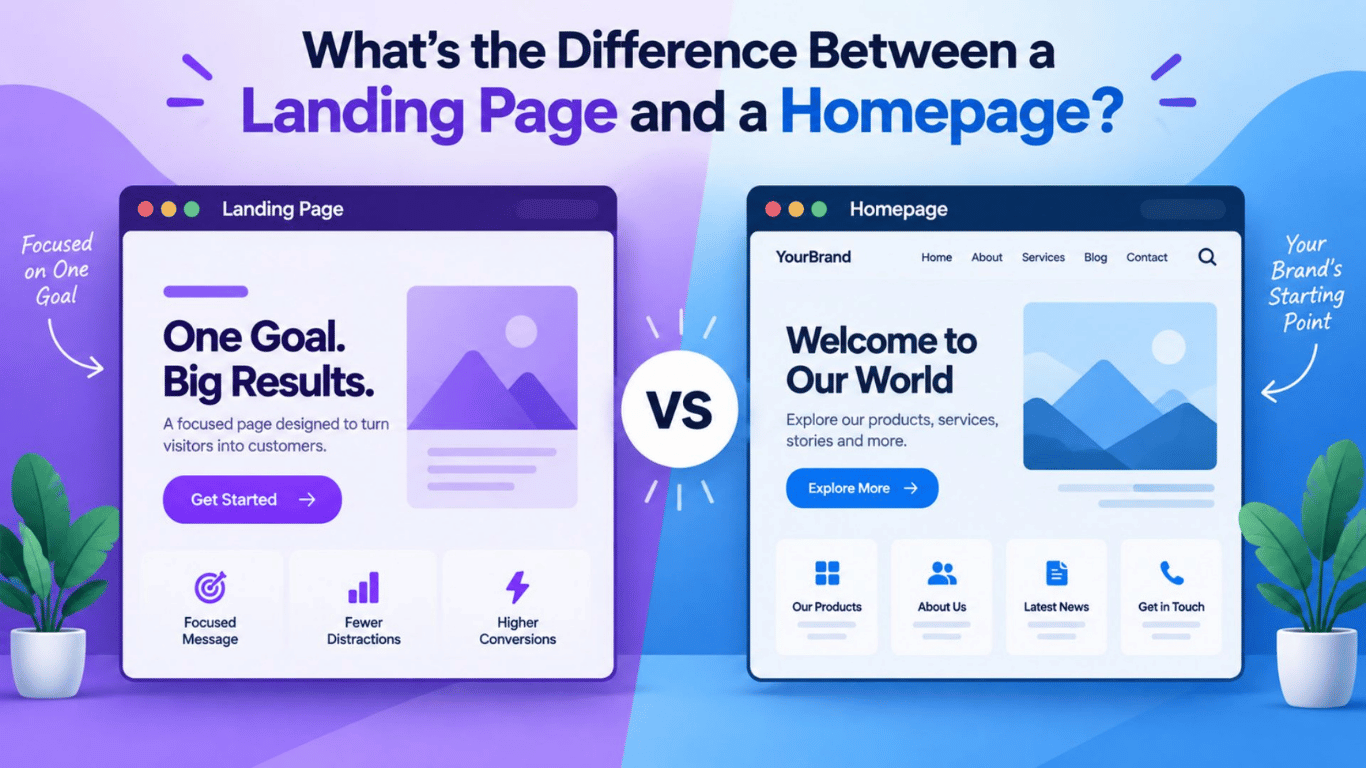
This is genuinely one of the most-asked questions in the category, so let’s settle it clearly. What’s the difference between a landing page and a homepage, and is a landing page the same as a homepage? No — they serve completely different jobs. A homepage introduces your whole business and offers multiple paths: About Us, Products, Contact, Blog. A landing page strips all of that away and focuses on exactly one offer, one action, one outcome.
Sending paid traffic to your homepage instead of a dedicated landing page is one of the most common — and costly — mistakes businesses make, since visitors get distracted by navigation options instead of completing the action you actually paid to drive them toward.
Why Landing Pages Are Important
Understanding why landing pages are important comes down to conversion math. A focused page with a single call to action consistently converts better than a general page trying to do everything at once — sometimes dramatically better. For any paid campaign, that difference directly affects your cost per acquisition: the same ad spend driving traffic to a purpose-built landing page instead of a busy homepage can mean the gap between a profitable campaign and a losing one.
Think about what happens when someone clicks your ad. They’re already in a specific mindset — curious about one offer, one product, one promise you made in the ad copy. If that click lands them on your homepage, they’re suddenly staring at a navigation menu, five different services, a slider, and three competing calls to action. That mismatch between expectation and experience is where most of your ad budget quietly disappears. A landing page closes that gap. It repeats the exact promise from the ad, removes every distraction that isn’t tied to that promise, and gives the visitor exactly one thing to do next.
This is also why landing pages tend to outperform on quality score and ad relevance metrics across platforms like Google Ads and Meta. When the page content, headline, and offer mirror the ad’s intent, algorithms read that as relevance — and relevance usually means a lower cost per click alongside a higher conversion rate. So the benefit isn’t just psychological for the visitor; it’s measurable in the ad platform’s own scoring.
There’s a business case beyond the numbers too. A dedicated landing page lets you test one variable at a time — a headline, a price point, a testimonial, a form length — without touching your main site. That kind of isolated testing is nearly impossible on a homepage serving ten different audiences at once. Over a few campaign cycles, those small, controlled tests compound into real gains in what you pay to acquire a customer.
In short, landing pages aren’t a nice-to-have add-on to a campaign — they’re the mechanism that makes paid traffic financially viable in the first place.
Do Landing Pages Help SEO?
A common question from businesses trying to justify the investment: do landing pages help SEO? The honest answer is yes, indirectly. A well-built, SEO-friendly landing page targeting a specific keyword or service can rank in search results on its own, expanding your visibility beyond your homepage. It also gives you a dedicated place to send backlinks and earned mentions, concentrating authority around a specific offer rather than diluting it across a general page.
Types of Landing Pages
There are several different types of landing pages, and choosing the right one for your goal matters as much as the design itself:
- Lead generation pages — collect contact information in exchange for something valuable, like a free guide or consultation
- Click-through pages — warm up a visitor with information before sending them to a purchase or signup page
- Sales pages — longer-form pages designed to sell a specific product directly
- Squeeze pages — minimal, single-field pages focused purely on capturing an email address
- Event or webinar pages — built around registration for a specific date and time
Choosing the wrong type for your goal is one of the most common reasons a page underperforms, regardless of how well it’s designed.
Landing Pages for Startups
Landing pages for startups often serve a different purpose than they do for established businesses — testing an idea before committing engineering resources to a full product. A simple landing page describing the concept, paired with an email signup, can validate real demand before a single line of product code gets written. This lean approach has become a standard early step for founders trying to avoid building something nobody actually wants.
E-Commerce Landing Pages
An e-commerce landing page works differently than a lead-generation page, since the goal is usually an immediate purchase rather than capturing contact information for later follow-up. These pages typically center on a specific product or promotion, with clear pricing, strong product imagery, and urgency elements like limited-time offers or stock counters. Cutting out general site navigation here matters just as much as it does for lead-gen pages — every extra link is a chance for a ready-to-buy visitor to wander off before completing the purchase.
Digital Marketing Landing Pages: Where They Fit in a Campaign
Within a broader strategy, digital marketing landing pages function as the connective tissue between an ad and a conversion. A Google or Facebook ad campaign without a dedicated landing page is essentially sending paid traffic into a black hole — no way to track what happens after the click, and no page specifically built to close the loop on the exact promise made in the ad.
How Many Landing Pages Should a Website Have?
There’s no universal number, but understanding how many landing pages should a website have matters more than people expect. The data consistently shows that businesses running more landing pages — each targeted at a specific audience segment, offer, or campaign — generate meaningfully more leads than businesses relying on just one or two generic pages. Instead of building one page trying to speak to everyone, multiple focused pages, each speaking directly to a specific segment, almost always outperforms a one-size-fits-all approach.
How to Optimize a Landing Page for Lead Generation
If you’re trying to figure out how you want to optimize a landing page for lead generation, a few elements matter more than the rest: a headline that immediately states the specific benefit, a form asking for the minimum information needed (every extra field reduces completions), social proof positioned near the call-to-action button, and a single, unmistakable next step rather than multiple competing buttons pulling attention in different directions.
Landing Pages Should Match Their Corresponding Ad Copy
One of the most overlooked ranking and conversion factors is message match — landing pages should match their corresponding ad copy, subject line, or search query word-for-word wherever possible. If someone clicks an ad promising “50% off winter boots” and lands on a generic homepage, the disconnect creates instant doubt and drives up bounce rates. Keeping the headline, imagery, and offer on the landing page consistent with whatever brought the visitor there in the first place is one of the simplest, most effective conversion improvements available.
How to Drive and Attract Traffic to a Landing Page
Building the page is only half the job — you still need to know how to drive traffic to landing page URLs effectively. Paid search and social ads remain the fastest route since they let you control exactly who lands on the page and when. Organic methods to attract traffic to landing page content take longer but compound over time: targeted SEO content, email campaigns to an existing list, and strategic backlinks from relevant industry sites all build sustainable traffic without an ongoing ad budget.
How Much Does It Cost to Build a Landing Page?
Answering how much does it cost to build a landing page honestly requires a range rather than a single number. A DIY page using a builder tool can cost next to nothing beyond the software subscription, but typically underperforms without conversion expertise behind it. A professionally designed and optimized page, built with copywriting, testing, and tracking in place from day one, represents a real investment — but one that usually pays for itself quickly through a meaningfully higher conversion rate compared to a self-built page.
Best Landing Page Design: Function Over Flash
When it comes to best landing page design, ClickFunnels co-founder Russell Brunson has long emphasized a philosophy worth repeating: a landing page’s job isn’t to win a design award — it’s to convert.
A beautifully designed page that confuses visitors about what to do next will lose every time to a simpler page with a crystal-clear call to action. Good design supports the conversion goal; it never competes with it.
This philosophy is central to how UpscoreTech approaches every landing page we build — design in service of the conversion, not the other way around.
Examples of Landing Pages That Convert
Studying real examples of landing pages that perform well reveals a consistent pattern regardless of industry: a single, clear headline stating the exact benefit, minimal navigation (often none at all), a form or button that stands out visually from everything else on the page, and genuine social proof — testimonials, logos, or numbers — placed close to the decision point rather than buried at the bottom of the page.
The Real Cost of a Slow or Confusing Landing Page
It’s worth remembering just how little patience visitors actually have once they land on your page.
As business leader Douglas Warner has put it, in the world of online customer service, your competitor is never more than a single click away.
That principle applies directly to landing pages — a slow-loading page, a confusing layout, or an unclear offer doesn’t just lose a conversion, it often sends that visitor straight to a competitor’s tab instead.
Why Work With an Agency for Your Landing Pages
Building landing pages that consistently convert requires more than a template and good intentions — it requires testing, copywriting expertise, and ongoing optimization based on real visitor data. This is exactly where UpscoreTech‘s landing page team focuses, building pages designed around your specific audience and offer rather than a generic, one-size-fits-all layout.
Final Thoughts
A landing page is a small piece of your marketing infrastructure that carries an outsized impact on your results. The difference between a page that converts and one that quietly wastes ad spend usually comes down to focus — one offer, one action, no distractions — rather than flashy design alone.
If you’re ready to build a landing page strategy around your specific business rather than guesswork, UpscoreTech can help.
Frequently Asked Questions
What’s the real difference between a landing page and a homepage?
A homepage introduces your whole business with multiple navigation paths. A landing page focuses on one specific offer and one action, with no distracting links pulling attention elsewhere.
Do landing pages actually help with SEO?
Yes, indirectly. A well-built, keyword-targeted landing page can rank on its own and gives you a dedicated place to concentrate backlinks and search authority around a specific offer.
How many landing pages does a small business actually need?
More than one or two generic pages. Businesses running multiple targeted pages, each built for a specific audience segment or campaign, consistently generate more leads than relying on a single all-purpose page.
How much should a business expect to spend building a landing page?
It ranges widely — a DIY builder page costs very little upfront but often underperforms, while a professionally designed page with copywriting and testing built in represents a bigger investment that typically pays for itself through a higher conversion rate.